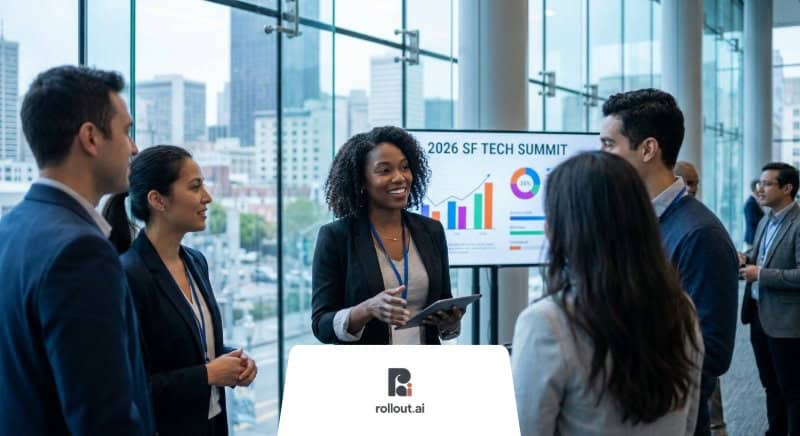


A product lead is trying to approve an AI pilot while finance is closing invoices, support is triaging tickets, and IT is reviewing vendor access before another team spends three days at sessions across town. That’s the real planning problem behind San Francisco tech conferences in 2026. A registration link doesn’t tell you who owns follow-up, which roadmap item changes, or whether a demo belongs in procurement.
This guide helps business, IT, operations, and startup leaders choose events that support real decisions, from AI pilots and cloud planning to vendor selection, customer workflows, and security reviews.
Rahul Dewan, CTO at Rollout AI, notes: “The best conference outcome isn’t a stack of notes. It’s a clearer next step, an owner, and a business reason to act.”
Tech Conferences In San Francisco Need A Business Filter Before Teams Commit Time And Budget
Teams lose time when conference plans start with excitement instead of ownership. Someone registers, three people join vendor demos, notes land in a shared folder, and implementation teams never see the decisions that affect their roadmap.
A useful filter starts with current work: missed customer meetings, stalled approvals, duplicate research, vendor follow-up, and notes that never become tickets, pilot plans, or budget inputs.
For San Francisco teams, event value comes from how well it supports work already moving through the business. A founder may need a clearer hiring or funding narrative. A revenue operations leader may need better CRM automation without breaking customer records. An IT lead may need to compare AI infrastructure options while keeping identity, data access, and incident response in view.
San Francisco Tech Conferences That Belong On The Shortlist
Use this shortlist to decide who should attend, what they should bring back, and which operating decision each event supports.
|
Event |
Date |
Location |
Best Fit |
Business Reason to Attend |
|---|---|---|---|---|
|
AI Engineer World’s Fair 2026 |
June 30 to July 2, 2026 |
Moscone Center or Moscone West, San Francisco, CA |
Engineering, AI platform, product, and technical leadership teams |
Compare build, deployment, and scaling practices for AI systems moving through proof of concept or production planning. |
|
Step San Francisco 2026 |
August 26 to 27, 2026 |
The Midway, San Francisco, CA, with Day 1 across the Bay Area |
Founders, startup operators, investors, and growth teams |
Understand how AI economy shifts affect funding, hiring, partnerships, product direction, and go-to-market timing. |
|
Dreamforce 2026 |
September 15 to 17, 2026 |
San Francisco, CA |
Salesforce admins, developers, revenue operations, IT, and customer-facing leaders |
Connect CRM, AI, automation, training, and product updates to sales, service, support, and customer data workflows. |
|
Fully Connected 2026 |
September 29 to October 1, 2026 |
Moscone South, San Francisco, CA |
AI infrastructure, cloud, data, DevOps, and platform teams |
Evaluate production AI, infrastructure cost, labs, and scaling requirements before committing budget or architecture. |
|
TechCrunch Disrupt 2026 |
October 13 to 15, 2026 |
Moscone West, San Francisco, CA |
Founders, investors, product leaders, and startup teams |
Pressure-test company-building assumptions, investor narratives, market timing, and scaling decisions. |

How To Compare Tech Events In San Francisco By Operating Priority
Event selection should begin with work already on the calendar: AI pilots, cloud planning, sales system changes, customer support workflows, security reviews, or partner development. That discipline matters because 36% of technology leaders acknowledge that AI is outpacing their cybersecurity capabilities.
Before teams commit travel time, turn each conference goal into an operating question. Which system is affected? Which team owns the change? Which customer, compliance, budget, or delivery commitment improves if the team comes back with the right answer?
-
Match roles to sessions: Assign sessions by the decisions each role owns.
-
Prioritize live access: Labs and workshops give better workflow evidence than broad keynotes.
-
Plan vendor follow-up: Tie meetings to active procurement, integration, implementation, or renewal needs.
-
Protect team capacity: Cover travel days, customer requests, ticket queues, and documentation before the badge is printed.
|
Operating Priority |
What to Validate at the Event |
Business Impact |
IT Control or Follow-Up |
|---|---|---|---|
|
AI pilots and automation |
Model governance, data access boundaries, human review steps, and integration with existing workflows |
Reduces the risk of launching AI use cases that create compliance gaps or unreliable outputs |
Require a post-event AI risk checklist covering data sources, approval paths, monitoring, and security ownership |
|
Cloud planning |
Architecture patterns, cost controls, resilience options, and migration dependencies |
Improves cloud roadmap decisions before committing engineering time or vendor spend |
Map event findings to workload tiers, identity controls, backup requirements, and budget guardrails |
|
Sales and customer systems |
CRM integrations, data quality controls, reporting flexibility, and user adoption requirements |
Helps revenue teams avoid tools that add friction or fragment customer records |
Document required APIs, permission models, data sync rules, and change management tasks |
|
Security reviews |
Threat detection capabilities, incident response workflows, audit evidence, and third-party risk practices |
Strengthens buying decisions where AI, cloud, and SaaS expansion increase exposure |
Convert vendor claims into security questionnaire updates, proof-of-concept tests, and control owner assignments |
|
Partner development |
Implementation capacity, support escalation paths, customer references, and roadmap alignment |
Improves the odds that event relationships turn into usable delivery or support capacity |
Schedule structured follow-ups with success criteria, technical contacts, procurement next steps, and timeline assumptions |
Explore San Francisco’s Tech Ecosystem
Choose Upcoming Tech Conferences In San Francisco Based On Your AI And Cloud Work
Teams should assess AI and cloud-focused events against implementation maturity, not curiosity alone. AI Engineer World’s Fair 2026 fits teams building and deploying AI systems, while Fully Connected 2026 is better suited for infrastructure, cloud capacity, and scaling conversations.
For upcoming tech conferences in San Francisco, start with the team’s current stage: proof of concept, production deployment, infrastructure cost review, governance design, model monitoring, or internal support planning.
An engineering manager may compare GPU capacity notes with ticket backlog trends before approving cloud expansion. An operations lead may turn AI takeaways into invoice routing rules, service coverage plans, and escalation paths that support real customer commitments.
The goal is to close workflow gaps, not add disconnected research. Conference sessions should clarify approval rules, data handoffs, support ownership, and risk review.
Cybersecurity Conferences In San Francisco Should Fit Into The Operating Plan
Don’t force a separate event category if the agenda already includes serious security content. Evaluate cybersecurity conferences in San Francisco alongside broader technology, AI, cloud, and enterprise software events by looking for sessions tied to access reviews, vendor risk, customer data handling, regulatory evidence, incident response, and AI governance.
Security stays close to operations because phishing changes daily work for IT and finance teams. APWG reports that phishing attacks have increased by more than 150% yearly since 2019, turning conference selection into readiness planning for access control and vendor review.
A finance team evaluating an automation tool needs more than a clean demo. They need to know who approves payment changes, how vendor bank details are verified, where audit evidence is stored, and what happens when a suspicious request hits the queue.
Turn Your San Francisco Tech Conference Insights into Actionable Backlogs
Don’t let summit takeaways get lost in unassigned vendor notes. Partner with local experts who turn event insights into structured project tickets, clear budgets, and practical plans.
How Leadership Teams Can Use Technology Summits In San Francisco To Sharpen Buying Decisions
Leadership teams need clear decision criteria before they walk an expo floor or join product briefings. More than 2 in 5 IT pros say AI-powered attacks will be the biggest game-changer in cybercrime over the next five years, so every software, AI, and automation purchase belongs in a broader risk discussion at technology summits in San Francisco.
If a tool touches customer records, identity access, financial approvals, support queues, or product data, the team should leave the event knowing whether the next step is a pilot, security review, budget request, or no action.
-
Define the business problem first: Connect sessions to slow approvals, manual data entry, broken handoffs, or unclear escalation rules.
-
Assign an internal owner: Name who captures notes, ranks vendors, and drives follow-up.
-
Separate demos from readiness: Check integration, access, training, support, reporting, and success criteria.
-
Track budget timing clearly: Match conversations to renewals, procurement windows, fiscal planning, and capacity.
-
Turn learning into backlog: Convert takeaways into tickets, pilot plans, vendor evaluations, or policy updates within one week.
Turning Tech Summits Into Operating Discipline
The value of tech summits shows up after the team returns. Schedule debriefs while details are fresh, consolidate notes, score vendors against active needs, and decide which ideas deserve a pilot, a security review, or an executive readout.
That discipline matters as nearly half of SMBs have updated their cybersecurity solutions, putting more pressure on teams to separate urgent improvements from noisy vendor claims.
We see the best results when teams treat the post-event week as part of the event itself. Notes need to move into project boards, ticket queues, procurement trackers, risk registers, roadmap docs, or executive summaries.
Aligning IT Conferences With Team Workflows And Customer Commitments
Organizational change is hard when teams are already managing tickets, customer expectations, roadmap deadlines, and security reviews. Treat IT conferences as working sessions inside daily operations, not separate learning trips. Deepfake risk is one reason to keep workflow and security ownership close; in 2024, an Arup finance worker transferred $25 million after a fake video meeting.
The operating plan should make follow-through visible. An attendee reviewing support automation should bring back notes on routing, escalation rules, reporting, permissions, and training. A leader comparing AI tools should capture data sources, approval paths, human review points, and monitoring requirements.
-
Set a pre-event objective for each attendee by role.
-
Use one capture template for sessions, vendors, risks, assumptions, decisions, and owners.
-
Schedule a 30-minute debrief within one week.
-
Convert approved ideas into backlog items, vendor evaluations, policy updates, or pilot plans.
Making Tech Seminars In San Francisco Useful After The Badge Scan
Tech seminars in San Francisco work best when each format has a business purpose and follow-up owner. That structure matters, adding urgency to sessions that touch identity, access, data movement, and employee workflows.
|
Format |
Best Use |
Follow-up Owner |
|---|---|---|
|
Hands-on lab |
Test workflow fit and integration effort |
Engineering or IT lead |
|
Product roadmap session |
Compare vendor direction with priorities |
Product or operations leader |
|
Founder panel |
Assess scaling lessons and partnerships |
Founder or strategy lead |
|
Investor session |
Pressure-test funding and positioning |
Executive team member |
|
Developer training |
Build near-term implementation knowledge |
Engineering manager |
|
Peer roundtable |
Validate practices with similar teams |
Department owner |
A hands-on lab should produce implementation notes. A roadmap session should produce a vendor risk or product fit assessment. A peer roundtable should produce one or two operating practices worth testing.
Bring Structure To Tech Trade Shows In San Francisco With Rollout AI
A strong plan for tech trade shows in San Francisco connects local access, community learning, technical sessions, vendor conversations, and internal follow-through. We help teams turn conference insights into practical AI, automation, workflow, and operational planning steps that support real decisions.
If you’re preparing for a 2026 event calendar, we can help map sessions to owners, convert notes into next steps, and keep implementation tied to capacity, risk, and customer commitments. For the product lead balancing an AI pilot, finance invoices, support tickets, and vendor access reviews, that structure turns a busy conference week into a usable operating plan. Book a meeting with Rollout AI and let’s turn the trip into a plan your team can use.